← All projects

Learning systems · Knowledge visualization · Applied AI

Learning Systems Lab

Pick a question, change one thing, and watch the reasoning respond.

A live lab of small, authored learning experiments and open-ended Learning Toys. It re-founded the 2025 learning platform after CertGraph and carries the graph line from myDNAHealth and the AWS Glossary Graph.

Where it is
Broader learning-system laboratory
Form
Case study
Updated
2026-09-11

The idea

Learning Systems Lab is for curious people who learn by poking at things, and it doubles as Christian's workbench. Technical material often arrives as dense dashboards or long explanations that show more while making the reasoning harder to follow. The lab tries the opposite: one focused question at a time, where a single change, like launching a ball faster or saving for longer, visibly reshapes the model in front of you.

Two kinds of pieces share the space. Experiments are short, ordered sequences with a question, an action, and a traceable answer. Learning Toys, such as a graph of the Apollo missions, are open ground with no score and no required path. The bet is that authored interactions, where every response traces back to a rule or a source, make reasoning easier to inspect than generated explanations, and that ideas proven here can feed focused products like CertGraph.

Today the lab is live. It was released on 5 September 2026 with four authored experiments, five Learning Toys, and a public lineage page tracing the graph idea back through myDNAHealth and the AWS Glossary Graph. Nothing in it has been tested with a group of learners yet, so it makes no claim about what anyone learns from it.

How it works

  1. Source
  2. Structure
  3. Explanation
  4. Practice

Authored experiments and Learning Toys, including a typed knowledge graph with neighborhoods and search and a constraint-deconstruction experiment. Content is authored and deterministic, with no live AI, uploads, or accounts.
Screens

All screens in the gallery →
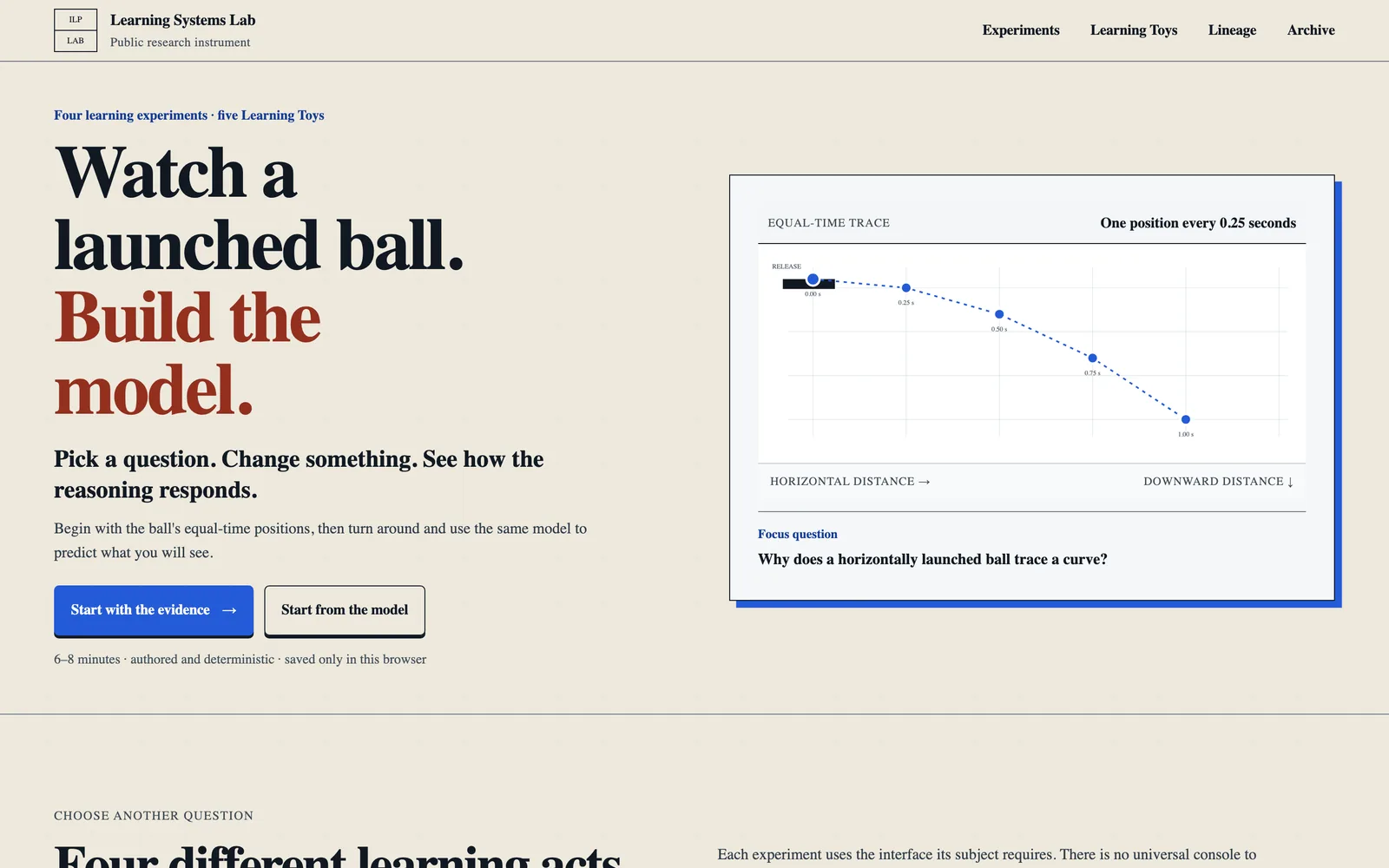
Learning Systems Lab home page headed “Watch a launched ball. Build the model.” with an equal-time trace of a horizontally launched ball.
Home page and Experiment 01. Local build, captured 24 September 2026.
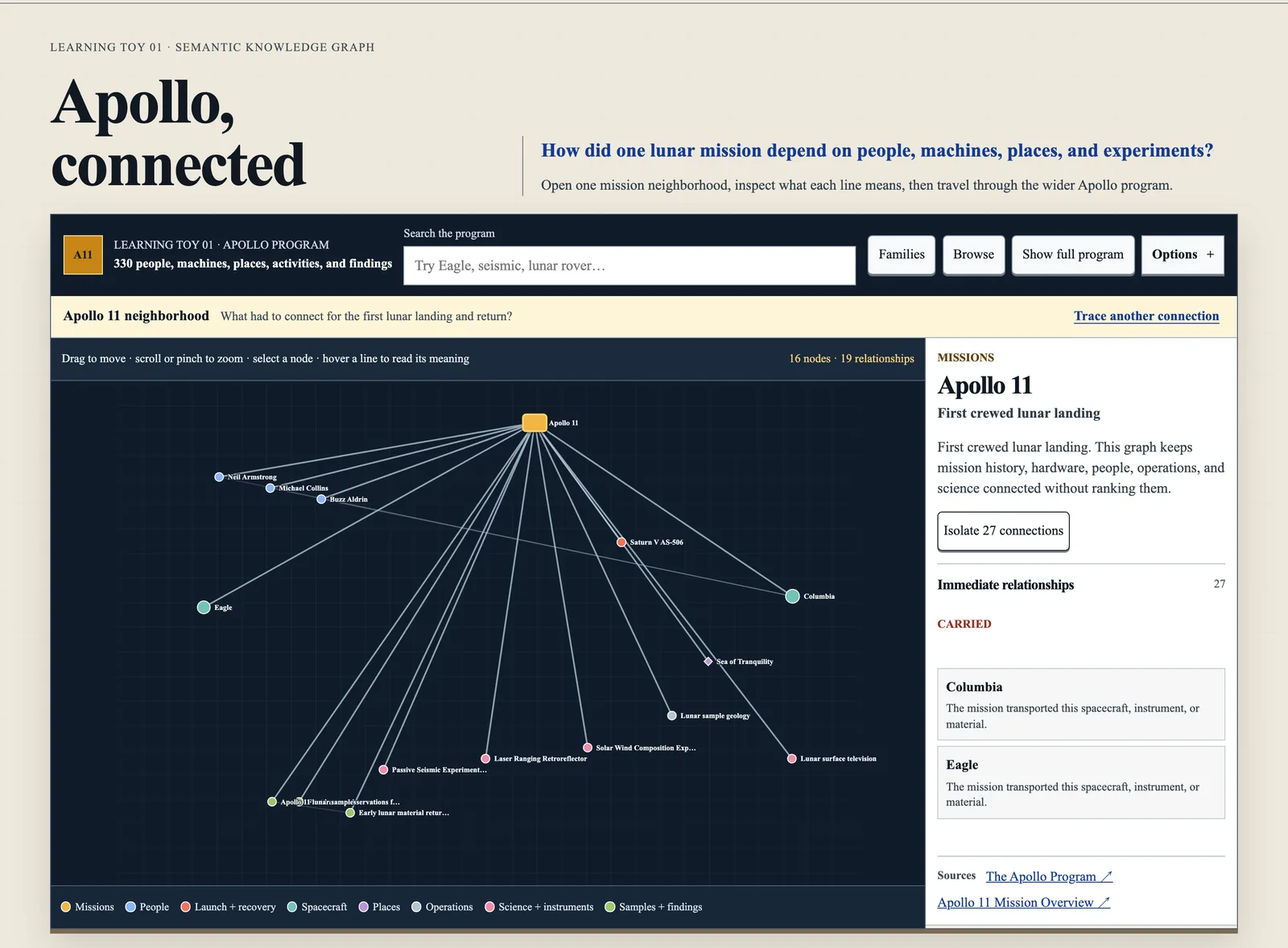
The “Apollo, connected” learning toy: a knowledge graph of the Apollo 11 neighborhood and a side panel describing Apollo 11 and its relationships.
Learning Toy 01, an authored Apollo knowledge graph that cites its public sources. Captured 24 September 2026.
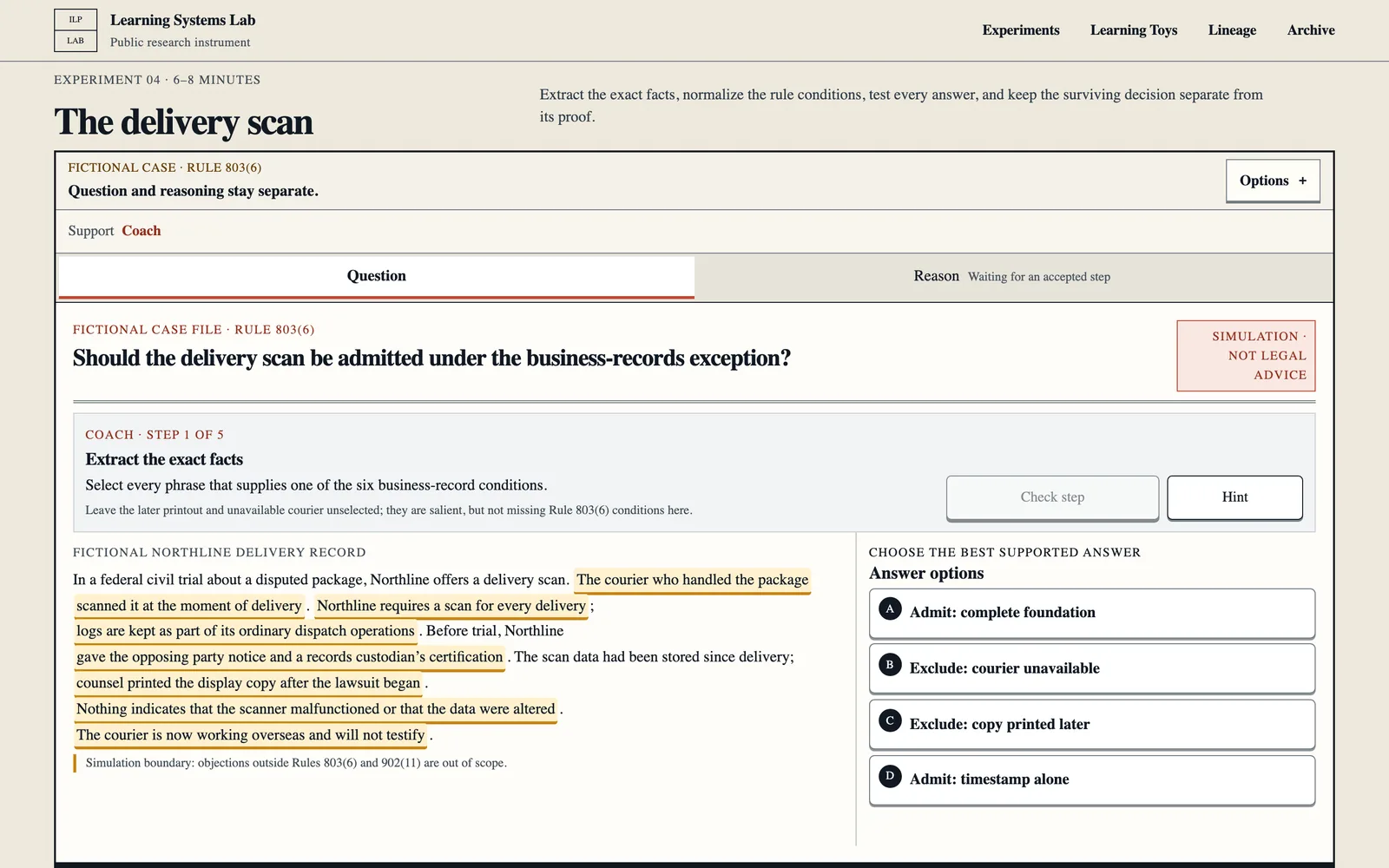
Learning Systems Lab Experiment 04, “The delivery scan”: a fictional business-records case with highlighted facts from the scenario and answer options to admit or exclude the scan.
Experiment 04, a fictional evidence-rule case where the question and the reasoning stay separate. Local build, captured 24 September 2026.
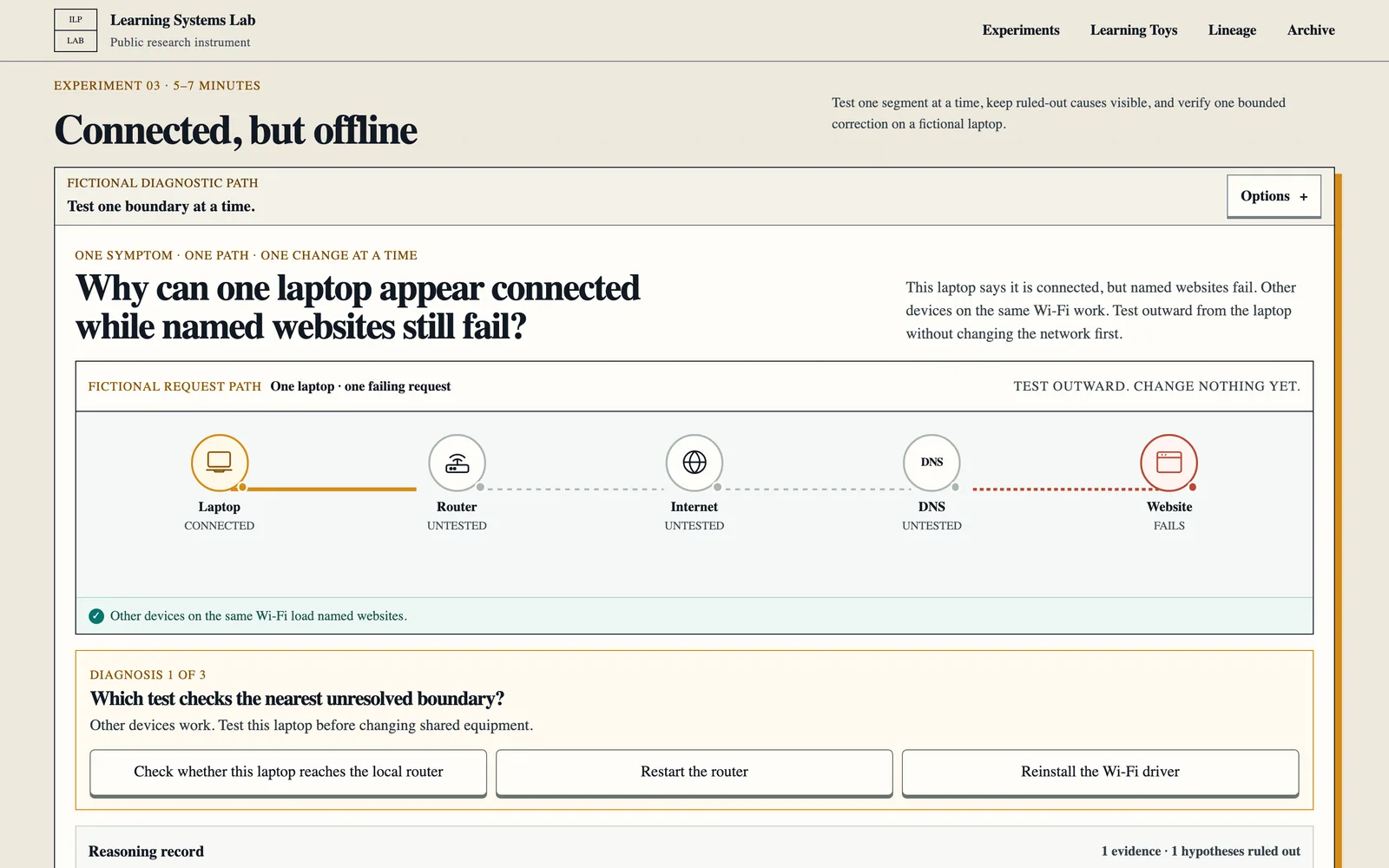
Learning Systems Lab Experiment 03, “Connected, but offline”: a fictional request path from laptop to router, internet, DNS, and website, with the first diagnostic question.
Experiment 03, a fictional network diagnosis tested one boundary at a time. Local build, captured 24 September 2026.
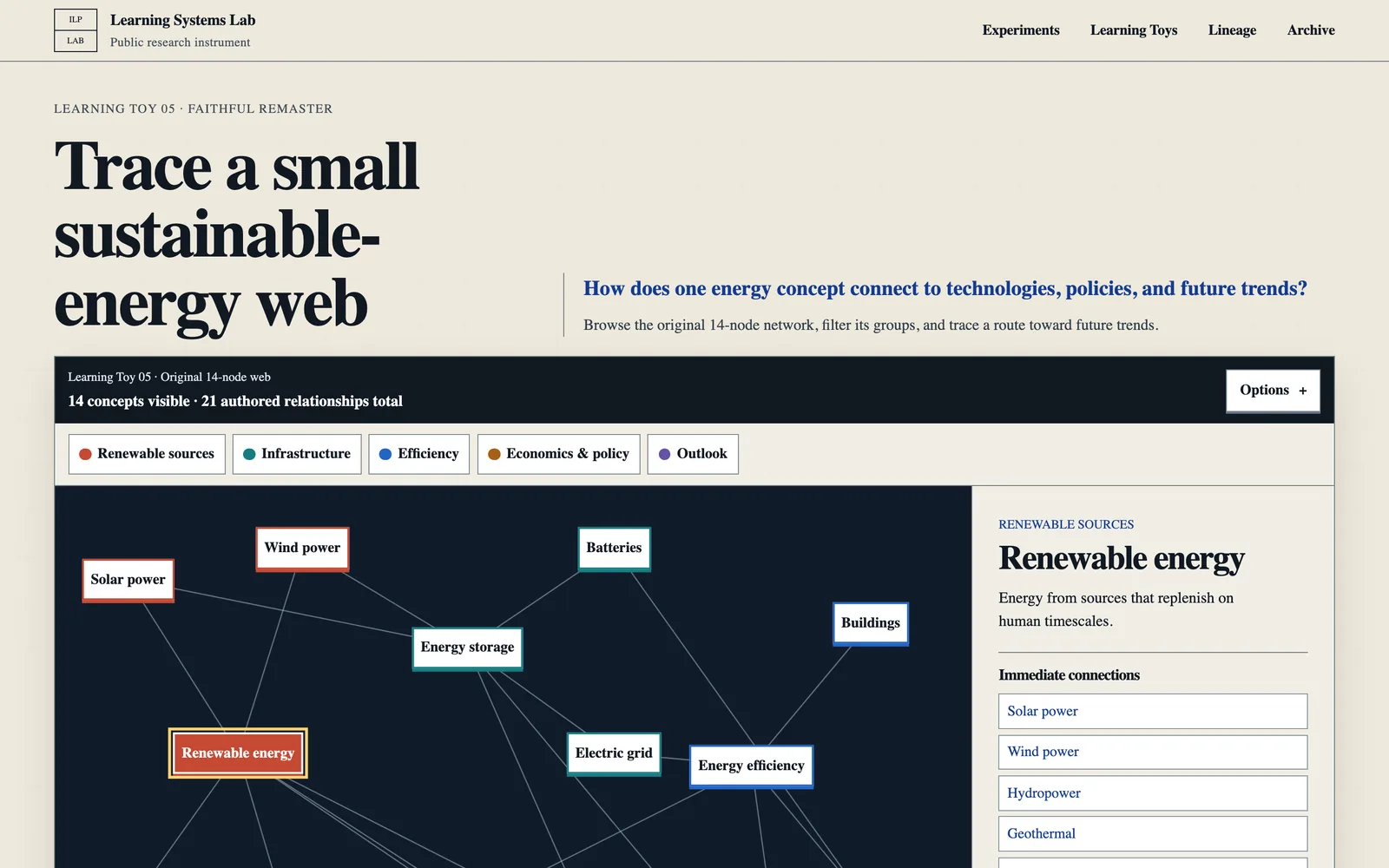
Learning Toy 05, “Trace a small sustainable-energy web”: a dark network of energy concepts such as solar power, wind power, batteries, and the electric grid, with a side panel on renewable energy.
Learning Toy 05, a remaster of an original 14-concept web. Local build, captured 24 September 2026.

Where it stands today

A deployed lab, released on 5 September 2026 with a public lineage page. Its experiments are authored and deterministic; the broad product thesis has not been validated with a cohort or a single learning outcome.

Working now

  • Knowledge-graph Learning Toy with typed relationships, neighborhoods, and search
  • Constraint-deconstruction experiment
  • Guided explanation surfaces

Not there yet

  • The platform still needs one technical domain, cohort, and measurable outcome.

How it got here

  1. First version: broad learning-platform demos, including a small force graph; its AI parts were scripted
  2. CertGraph's first draft began among its drafts
  3. Re-founded as Learning Systems Lab around a shared constraint spine, borrowing CertGraph's traceable evaluator design
  4. Production release, with a public lineage page

What comes next

Next step

Document the laboratory role around CertGraph.

After that

  1. Use the lab for reusable research and visualization components
  2. Run narrow experiments through CertGraph

Proof and fine print

Dated evidence

  1. Legibility and product-separation review completedreview

Boundaries it keeps

  • Broad feature coverage is not learning efficacy
  • CertGraph remains a separate focused product
  • The 2025 version's AI features were scripted, not live

Christian's role

Directed the learning interfaces and knowledge-visualization experiments, and decided the separation that produced CertGraph.